
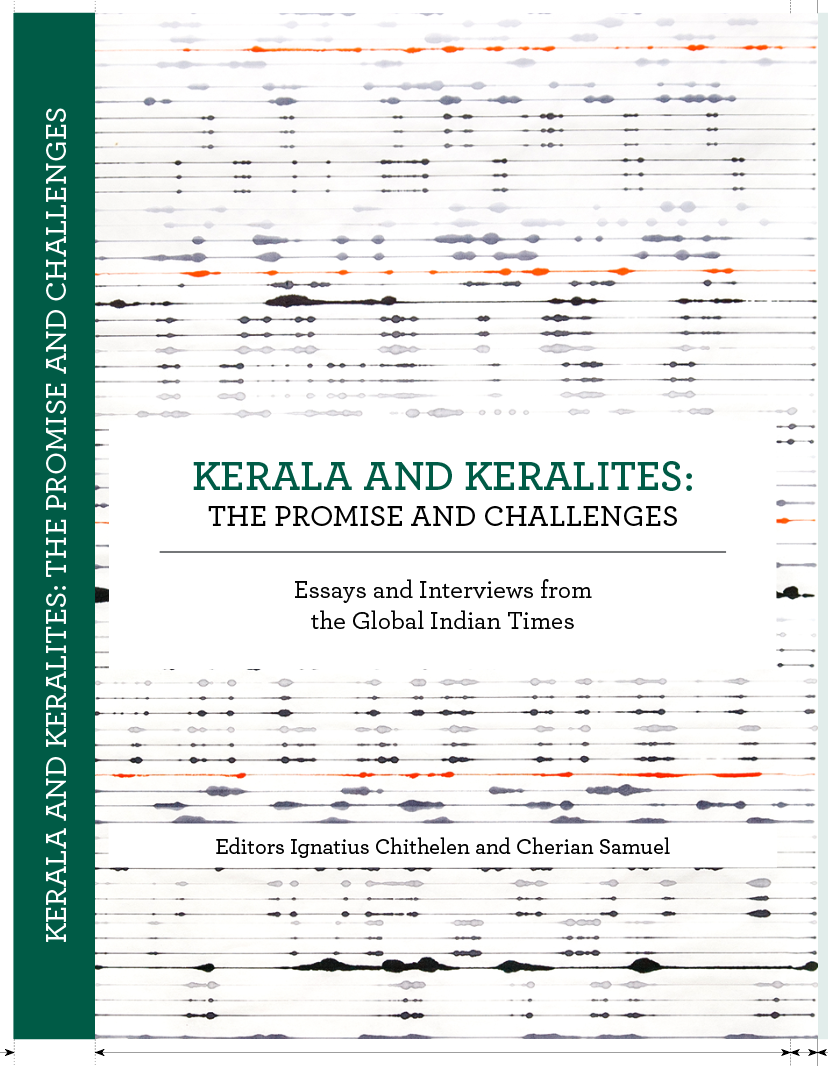
Cover design by Visakh Menon. Based on his painting series Tremors, Archival ink on xuan rice paper, 54x27 inches, 2019.
BUY Kerala and Keralites. US: E-book - On BookShop.org On Amazon
US, UK, Australia: Paperback Hardcover Get a discount buying from IngramSpark, the distributor
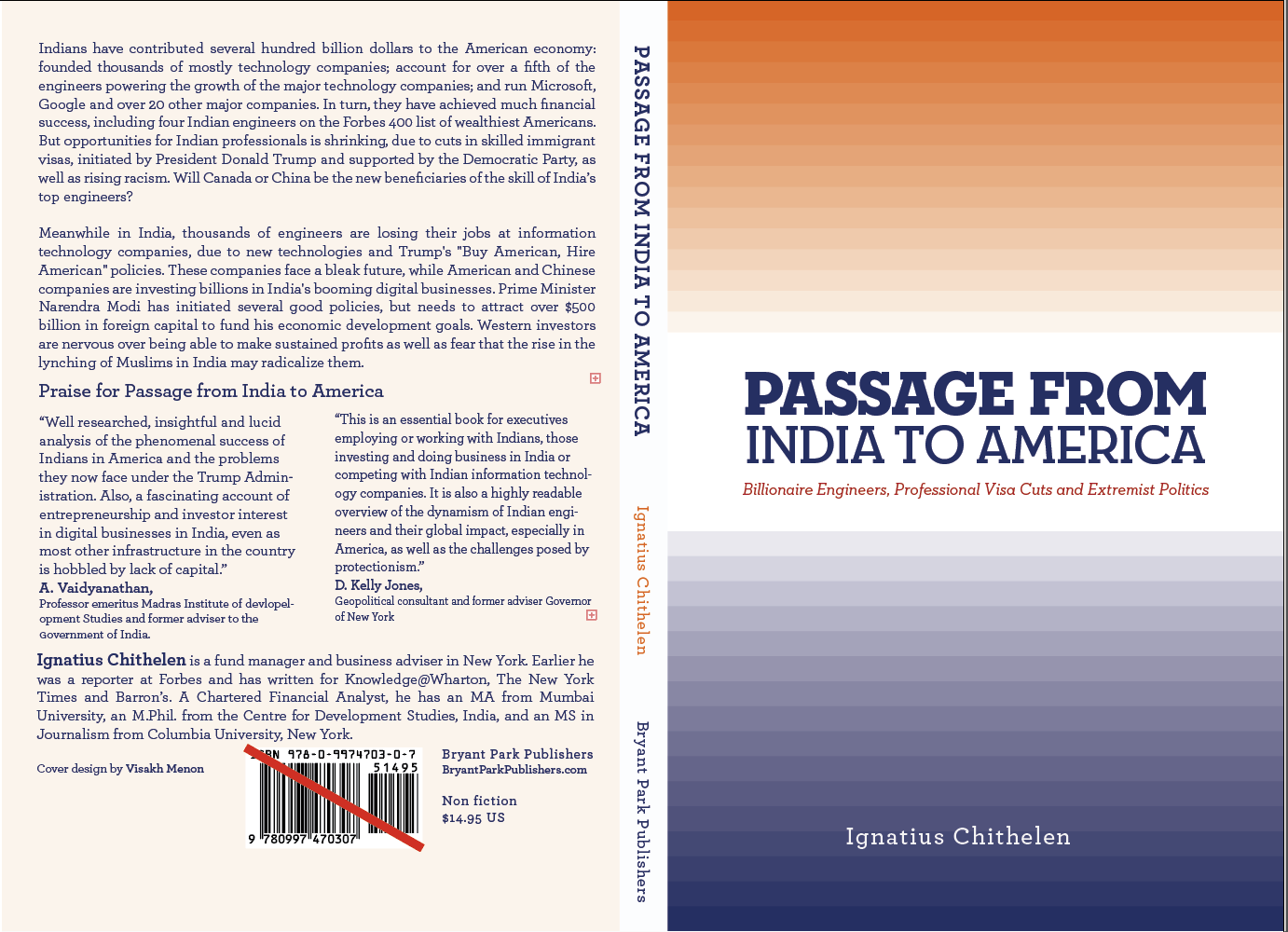
Passage from India to America
To Buy a copy of Passage from India click on a country link below
US: E-book - On BookShop.org
India
US, UK, Australia: Paperback Hardcover Discount of 15% to 45%.
Reviews and Advance Praise
Ignatius Chithelen is a trained social scientist and journalist and both sets of skills are on impressive display in this book…Indian engineers in the U.S. give themselves to contracts where the sword of the visa is always hanging over their heads…A third of the food rots in India. The country has less than a sixth of the number of refrigerated trucks and only 1% of the cold storages needed to preserve food and vegetables in transit.
Romar Correa’s review in the Economic & Political Weekly. Correa retired as the Reserve Bank of India Professor in Economics, Mumbai University.
Well researched, insightful and lucid analysis of the phenomenal success of Indians in America and the problems they now face under the Trump Administration. A fascinating account of entrepreneurship in digital businesses in India, even as most other infrastructure is hobbled by lack of capital.
A. Vaidyanathan, former adviser government of India & director Madras Institute of Development Studies
I highly recommend this book for insights into the glaring shortcomings of both current U.S. and Indian government policies. Ignatius’ bi-national perspective exposes the intellectual and commercial loss due to the embrace of parochial views.
Peter Fusaro, Chairman, Global Change Associates, New York, and author “What Went Wrong at Enron” a New York Times bestseller.
Using the Indian diaspora’s impact in the US and in India, Ignatius reminds his fellow Americans and his kin in India that neither America nor India will benefit without acceptance of co-existence.
Rahul Saxena, former Senior Vice President & head of International Strategy, European and Indian operations at Verizon; co-founder of Vodafone-Italy.
This is essential reading for American executives employing or working with Indians, those investing and doing business in India or competing with Indian IT companies. Incisive overview of the impact of Indian engineers in America as well as the challenges posed by protectionism.”
D. Kelly Jones, former adviser Governor of New York and geopolitical consultant
An in depth, eye-opening read supported by hard facts, astonishing and helpful statistics. A must read for anyone interested in India’s present and future.
Annette Herfkens, former Managing Director, Emerging Markets, Banco Santander Madrid & New York; author of best-seller “Turbulence, a True Story of Survival”

SIX DEGREES OF EDUCATION: From Teaching in Mumbai to Investment Research in New York
by Ignatius Chithelen
To Buy a copy of Six Degrees of Education click on a country link below
US: E-book
INDIA
US, UK, Australia: Paperback Hardcover Discount of 15% to 45%
About the book
Ignatius Chithelen says he is a goat and not an Asian Tiger – in Mumbai he read Dostoevsky instead of mastering calculus. His search for journalism and Wall Street jobs provide an unorthodox guide for changing careers. He discusses how competitive exams enable India to produce world class engineers, while 15% of college graduates are unemployed; the puzzle of India’s elections; and its five religions, four castes and 22 major languages. Along the way, he loses Santa Claus in Mumbai; fears arrest during Indira Gandhi's Emergency; is saved from drowning; finds his lost briefcase, with $3,880, in New York; and overcomes writer's block.
Praise for Six Degrees of Education
“Part advice to young professionals, this is a fun read…Adventures in Mumbai and New York are told with a reporter's eye and a financier's tallying of life's wins and losses.”
Sree Sreenivasan, Chief Digital Officer, Metropolitan Museum of Art, New York, & former Professor Columbia School of Journalism.
“This memoir extraordinaire is pure pleasure accompanied by humor, innocent charm, and an intelligent voice …It holds great appeal for both the hard cover and digital generations.”
Carol Pozefsky, Former Anchor/Reporter NBC and CBS Radio Networks
“A fascinating journey from the teeming middle class and hustle of Mumbai to the financial markets of New York…The events, people and Chithelen’s honesty make the story endearing. “
Anand Sudarshan, serial entrepreneur & former chief executive Manipal Global Education Services
"The intellectual range and curiosity of this superbly written book is the perfect remedy to the shortsighted perspective of many business thinkers…It offers the perfect balance of personal details and the big-picture insights of an informed observer. This is a must-read…to understand the significance of globalism today."
Charles A. Riley II, Professor of journalism, City University of New York, & author of Small Business, Big Politics
“A unique perspective on education, careers, politics and business in India…You also see New York and America differently as Chithelen makes his way from journalism to finance and builds a life far away from Mumbai.”
Alby Anand Kurian, faculty MDIS Singapore and author of The Peddler of Soaps
"Ignatius Chithelen has been a schoolteacher, reporter, copy editor, investment analyst, founder of a fund, advisor to flea market vendors. But all he has ever managed, as he freely admits in this funny, moving, and relentlessly candid memoir, is to retain his independence and integrity...I wish more Everymen would write books like this one".
Ashok Mahadevan, former editor Reader’s Digest India and author of upcoming Storm in a Teacup – his first and last novel.
About the author
Ignatius Chithelen is manager of Banyan Tree Capital in New York. Earlier he was an analyst and fund manager at First Eagle (SoGen) funds. A former reporter at Forbes, he has written for Knowledge@Wharton, The New York Times and Barron’s. His essay on Indian Entrepreneurs in the U.S. was published in both editions of The Oxford University Press Companion to Economics in India. A Chartered Financial Analyst, he earned an M.Phil. in Development Economics from the Centre for Development Studies, India, an MS in Journalism from Columbia University, New York and an MA in political science from Mumbai University.