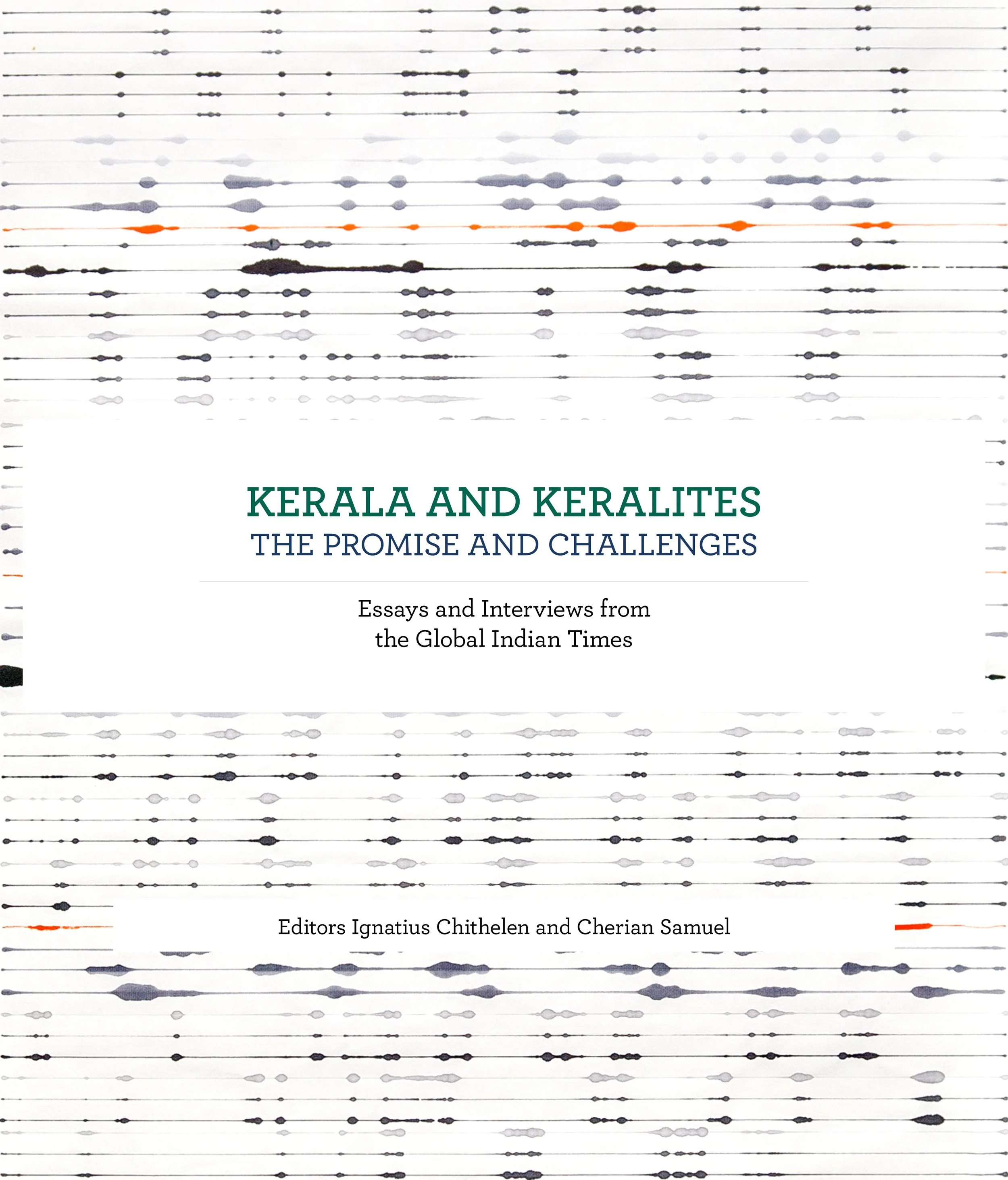
From the Foreword by Paul Kattuman
Professor, Cambridge Judge Business School
Kerala’s public image is often made too simple. It is praised as India’s most literate state, a haven of social development, a broadly left-led welfare success, a land of migrant remittances, and a place of relative coexistence. All these descriptions contain some truth, but not, by any means, the whole truth.
Taken together, this collection of essays, interviews, profiles, and reflections, suggest that Kerala is best understood as a globally connected social formation, not contained by its territorial borders. There is the Kerala of land, institutions, and public policy; the Kerala of families, language, memory, and community life; and the wider Kerala carried by migrants, remittances, care networks, business ties, and cultural identity.
The story of Kerala is also the story of a dispersed people: a worker in the Gulf, a nurse in Europe, a student in Bengaluru, a returnee in Kochi, and an ageing parent in Kottayam. Their lives are connected by remittances, care, obligation, memory, and the uneven consequences of migration.
The chapters in this volume approach Kerala’s development from different angles, but a common theme runs through them. They ask us to look at Kerala plainly: as a society of real achievements and serious contradictions. The Kerala Question is no longer whether human development matters. It is whether Kerala can turn human development into secure livelihoods, greater autonomy for women, environmental security, and a future that more people can imagine within Kerala itself.
Paul Kattuman is Professor of Economics at Cambridge Judge Business School, and Director of Studies in Management and Fellow of Corpus Christi College, University of Cambridge.
From the Preface
This book offers valuable, practical insights on Kerala’s economic future, including prospects for jobs, education, housing, farming, tourism, nursing and the status of women. It explores Kerala’s unique socio-economic condition: high literacy, good healthcare and welfare programs. Yet, high unemployment, high labor costs, growing budget deficits, and dependance on income from workers in the Persian Gulf. In addition, the profiles of 21 accomplished Keralites, provides insights on career and education paths for Keralites as well as non-Keralites.
In Kerala, unlike in many other Indian states, there is more religious tolerance between Hindus, Muslims, and Christians. In fact, a chapter in the book profiles Abraham Barak Salem, a Jewish lawyer and politician, known as the Jewish Gandhi of Kochi, Kerala.
Editors: Ignatius Chithelen is publisher Global Indian Times and manager Banyan Tree Capital, New York. Cherian Samuel, a writer based in Virginia, earlier was at the World Bank Group in Washington DC
Kerala and Keralites is now available worldwide
To buy a copy, in your region, click on format and store below
INDIA: Paperback
US: E-book - BookShop.org Apple Store Amazon
US: Paperback Buy at a discount price from IngramSpark
UAE, Saudi Arabia, Qatar, Middle East: E-book via Amazon
Southeast Asia: E-book via Amazon
UK: Paperback Buy at a discount price from IngramSpark
Australia: Paperback Buy at a discount price from IngramSpark
European Union: Paperback
Net income, if any, from this book will be donated as copies of classic books in literature, science, economics, and other fields, to a public library in Kerala. Global Indian Times is run by volunteers as a way of giving back to India.
Reviews and Extracts
Advance Praise for Kerala and Keralites
Saeed Mirza filmmaker, Chair, K.R. Narayanan film school, Kerala
Kerala and Keralites is an important document of articles, essays and interviews on the achievements of the people and the state. The enormous progress in education, welfare, women’s rights, and healthcare, in tiny Kerala, serves as an example for policy makers in other Indian states. Well done Ignatius Chithelen and Cherian Samuel.
Saeed Akhtar Mirza, is Chairman, K.R. Narayanan National Institute of Visual Science & Arts, a film school in Kottayam, Kerala. Mirza’s films include Albert Pinto Ko Gussan Kyoon Aata Hai, 1980, and Naseem, 1995; his TV serials include Nukkad, 1986; and his books include, Ammi: Letter to a Democratic Mother
Rick Oliver former Professor, global business, Cornell and Vanderbilt Universities
With their highly educated youth, educated and trained to work smart and hard in the new technologically skilled workplace, and a favorable economic climate, Kerala leads India in rapid economic growth. As the world’s population grows and ages, and the use of AI expands, demand for skilled Indian professionals, such as nurses trained in Kerala, will grow dramatically.
This book provides rare, insightful analysis of the Kerala “miracle.” Like Kerala, it's the best of the breed!
For nearly 30 years, Rick Oliver has been an advisor to and investor in education, commercial, and philanthropic organizations in India. He is the founder of American Sentinel University online nursing school, and a retired professor of strategy and global business at Vanderbilt and Cornell University's management schools. He is the author of more than a dozen books, many of which are available in multiple languages, and has served on the boards of ten public business and investment firms.
Ritu Dewan Visiting Professor, Institute for Human Development, New Delhi
Kerala and Keralites is a singularly unique array of creatively selected articles, interviews and vignettes, focusing on structurally interconnected multiple and myriad issues. The central focus is the spectacular historic achievements of the Kerala model and its people, and the need to extend and deepen the internalisation and simultaneously the externalisation of these attainments without romanticization. Essential to this rainbow collection is the incorporation of democracy, debate, and dissent that cuts through hierarchies, divides and diversities, without losing sight of lived experiences and realities.
Renowned experts and practitioners have contributed to this book, consistently interlinking academic rigour, advocacy and action, as a tribute to CDS and to the people of Kerala.
Ritu Dewan is Visiting Professor, Institute for Human Development, New Delh; President, 64th Conference of Indian Society of Labour Economics; former President, Indian Association for Women Studies; and Retired Director and Professor, Department of Economics, University of Mumbai.
Prabhu Guptara, Visiting Fellow, Judge Business School, University of Cambridge
“The average Indian, if asked to name the most desirable place to live in India, will almost unhesitatingly say Goa or Bengaluru. Most Indians remain unaware that it is Kerala which tops the country in practically every measure of development - quality of life, education, security, freedom, health, care of children, women, the elderly, the environment, …. That peculiar gap in public awareness is the most important reason for recommending Chithelen and Samuel’s gathering of materials that providformation on this extraordinary Indian state in bite-sized chunks that one can digest easily and quickly”
Prabhu Guptara, Publisher, Pippa Rann Books; Fellow, Judge Business School, University of Cambridge, U.K.; former Executive Director UBS Wolfsberg
Rajat Kathuria, Dean, Professor Economics, Shiv Nadar University, Delhi
This volume offers a rich and engaging portrait of Kerala through multiple lenses—economics, business, culture, science, history and public policy. Bringing together scholars, journalists, practitioners and entrepreneurs, it captures the complexity of a remarkable State through essays, interviews and commentaries. The presence of celebrated voices lends authority and perspective to the collection. Readers familiar with Kerala will find fresh insights, while those discovering it for the first time will appreciate its breadth, diversity and intellectual richness.
Rajat Kathuria is Dean, School of Humanities and Social Sciences and Professor, Economics at Shiv Nadar University, Delhi. Earlier, he taught at the International Management Institute, New Delhi, and was a consultant for the World Bank, Washington DC.
Jayant Menon Visiting Senior Fellow ISEAS, Singapore, and former Lead Economist, ADB
Kerala and Keralites have often made world news; this occurred most recently when the then Chief Minister Pinarayi Vijayan announced on 1 November 2025 that the state had eliminated extreme poverty. This was a concrete achievement, demonstrating Amartya Sen’s approach to development by prioritising substantive freedoms through public action and collective engagement. The widely publicised achievements in literacy, education, health and other social indicators had now found realization in a metric that was almost unique for a lower middle-income economy, nestled within a country with the highest number of the world’s poor or near poor.
It is against this backdrop that this timely volume by Ignatius Chithelen and Cherian Samuel, bringing together essays and interviews originally published in the Global Indian Times (GIT), is a welcome addition to the chronicles on Kerala and Keralites. While it rightly celebrates the many achievements in Kerala and by Keralites, it also recognizes the many challenges that exist, not least of which is the sustainability of its economic model. Kerala relies heavily on exporting its most valuable resource – its people - but this is not a sustainable long-term development strategy and is becoming increasingly risky amid rising conflict and global protectionism. The recent conflict in Iran is a case in point, resulting in calls to reduce the reliance on remittances to fuel consumption-led growth and transitioning to investment-led production.
The various challenges faced in making this necessary transition, to safeguard the many social achievements without completely abandoning the system that delivered them, make up many of the chapters in the volume including in the interviews with prominent Keralites around the world. The volume should be of interest to those fascinated not only by the Kerala story, but more generally to those who value the understanding of alternative approaches to economic development and social progress, and the extent to which it might be generalized to other developing economies.
Jayant Menon is a Visiting Senior Fellow at ISEAS, Singapore. He is an adjunct at Australian National University, University of Nottingham, UK, and IDEAS, Malaysia. Earlier, he was a lead economist at the Asian Development Bank. He has authored more than 15 books.
Priya Menon, Professor, Troy University, US
Kerala and Keralites: The Promise and Challenges explores one of India's most remarkable development stories. Through essays and interviews with leading scholars, economists, and practitioners, the book examines Kerala's achievements in education, healthcare, migration, entrepreneurship, and social development alongside its persistent economic and demographic challenges. Richly informed by evidence and lived experience, it offers fresh perspectives on the state's past, present, and future.
Why has Kerala achieved high levels of literacy, healthcare, and social development while many of its educated young people continue to seek opportunities elsewhere? This collection of essays and interviews examines the state's economy, migration, business, agriculture, public policy, and culture through the work of scholars, journalists, and practitioners. Rather than celebrating or criticizing Kerala, the contributors ask what explains its successes, what constrains its progress, and what lessons its experience offers for the future.
An essential volume for anyone interested in Kerala, India, and global development.
Priya Menon is a Professor of English and Director, University Honors Program, at Troy University, Alabama, US. A Fulbright Scholar, she has written on migration, gender, and culture in Kerala, including the impact of Keralite migration to the Persian Gulf. Her works have also examined representations of power, gender, and social hierarchy in the works of Arundhati Roy, Kamala Das, and Adoor Gopalakrishnan.
Mukul Pandya, former Executive Editor, Knowledge@Wharton, Philadelphia, US
The contributors have assembled a rich and thought-provoking collection that captures both the promise and the paradoxes of Kerala. The book moves beyond familiar celebrations of the Kerala Model to ask deeper questions about opportunity, migration, entrepreneurship, and the future of one of India's most educated and globally connected states.
Grounded in data yet highly readable, the book offers valuable insights for Keralites, policy makers, scholars, and anyone interested in how societies translate human development into lasting prosperity. It deserves a place on your bookshelf.
Mukul Pandya, former Executive Editor, Knowledge@Wharton and Senior Fellow Wharton School; former Associate Fellow and Consulting Editor, University of Oxford Said Business School.
Kerala and Keralites is now available worldwide
To buy a copy, in your region, click on format and store below
INDIA: Paperback
US: E-book - BookShop.org Apple Store Amazon
US: Paperback Hardcover Buy at a discount price from IngramSpark
UAE, Saudi Arabia, Qatar, Middle East: E-book via Amazon
Southeast Asia: E-book via Amazon
UK: Paperback Hardcover Buy at a discount price from IngramSpark
Australia: Paperback Hardcover Buy at a discount price from IngramSpark
European Union: Paperback
Net income, if any, from this book will be donated as copies of classic books in literature, science, economics, and other fields, to a public library in Kerala. Global Indian Times is run by volunteers as a way of giving back to India.